
Maximum Variation Sampling: What It Is and How To Do It

May 2026
About the author: Bonnie Lakusta is a Project Lead at Three Hive Consulting and a Credentialed Evaluator with a doctorate in psychiatry. Bonnie’s background is grounded in research, project management, and change management within healthcare. She brings expertise in facilitation, quality improvement, and evaluation design, with a focus on creating usable data and clear, memorable key messages tailored to diverse audiences.
This article is rated as:
In evaluation, we rarely have the time, budget, or access needed to hear from everyone. And if we only include the easy-to-reach or most available participants, we may end up with a narrow view of what happened, not reflective of the diversity of experiences. Maximum variation sampling is a purposive (that is, non-random) sampling approach that helps you intentionally include participants with very different experiences.
What is maximum variation sampling?
Maximum variation sampling means deliberately selecting participants that vary as much as possible on characteristics that matter to your evaluation, things like location, role, experience, outcomes achieved, or barriers faced. The point is to capture variation in perspectives that will help you uncover both common patterns that emerge despite different characteristics and meaningful differences between groups that help explain why the program works, when, and for whom.
This may sound a little like stratified sampling, which is when you divide your population into groups, based on characteristics that matter to your evaluation and randomly sample within the groups.
The easiest way to separate the two sampling approaches is to ask: What am I trying to claim at the end? If you want to understand the range of experiences and why those experiences differ, maximum variation sampling is good choice. If you want to estimate or compare (e.g., by region, role, or demographic group), you’re usually in stratified sampling territory. Maximum variation sampling does not rely on random sampling, each case is selected, whereas stratified sampling defines groups (“strata”) and then applies random sampling.
When should you use maximum variation sampling?
Maximum variation sampling is especially useful when you:
Have a limited capacity for qualitative data collection.
Need to understand how and why outcomes differ across settings, sites, or participant subgroups.
Suspect the program experience is not uniform (e.g., different delivery models, different implementers, different barriers).
Are doing case studies and you want to spotlight different experiences.
You may not want to use maximum variation sampling if your primary question is about how many (i.e., percentages, rates, population estimates). In those cases, random sampling or stratified random sampling would be better options. Here’s a broad primer on sampling decisions and recruitment strategies.
Notably, maximum variation sampling can be used for any data collection method, but it most often applies to qualitative methods, like interviewing.
How to do maximum variation sampling
Step 1: Start with your evaluation question(s)
Be clear on what you’re trying to learn. Maximum variation sampling works best when your questions are about experiences or context.
Example questions:
What helped or hindered participation?
How did implementation differ across sites?
Why did some participants benefit more than others?
Step 2: Pick 1–4 characteristics that matter
Decide which characteristics could plausibly change the outcomes you are measuring. Keep this list tight; too many dimensions make recruitment burdensome or even unrealistic. Common characteristic options in evaluation include:
Site: urban/rural, different regions, different delivery partners
Role: participants, caregivers, frontline staff, managers, referral partners
Experience with the program: high vs low attendance; completed vs dropped out
Outcome level: strong improvement vs little/no improvement; intended vs unintended outcomes
Equity-relevant factors*: language, accessibility needs, income, community identity (*Caution: be clear and transparent about your use of these variables in your evaluation plan and in your informed consent process if you plan to use them for comparison or grouping participants. Let participants know they were selected because they represent such groups)
Program pathway: different streams, cohorts, or service models
Step 3: Define your range
For each characteristic that you’d like to sample, define the range you want represented.
Example definitions:
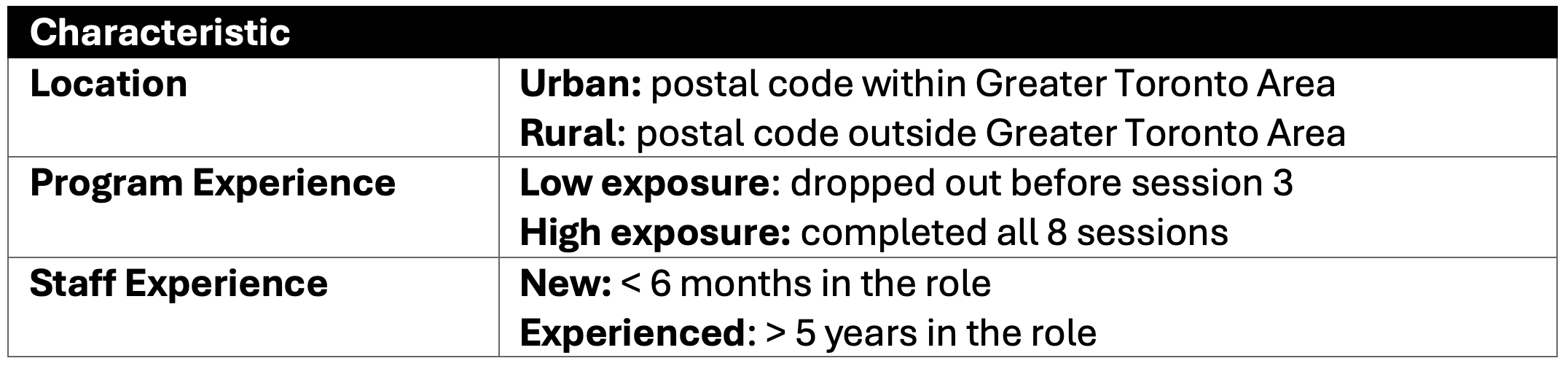
You’ll notice these definitions leave gaps: no one is included who completed 3 -7 sessions, or no one is included who has been in the role for 6 months – 5 years. That’s ok! Maximum variation sampling isn’t about perfect representation; the goal is to highlight a maximum variation, that is, exploring the biggest differences.
What if your categories overlap?
So far so good, but…what if the 2 or 3 characteristics you choose to sample have overlap? (which is definitely more likely than not!) In the above example, a participant may live rurally and have high program exposure. Your recruitment goal isn’t to stress about finding the perfect participant in each possible group, but to ensure that you have coverage. Here’s a simple way to handle overlap without turning your recruitment plan into a spreadsheet nightmare:
Pick a primary characteristic. Ask yourself which difference you want to explore the most, probably the one that is likely to have the biggest influence on your outcomes. Treat the other characteristic(s) as secondary.
Set minimums, not perfect quotas. Instead of trying to get equal numbers everywhere, set a minimum target for each group you care about.
Recruit in waves and fill gaps. Do a first wave across your primary characteristic (e.g., get a mix of urban and rural), then use wave two to target missing outcome experiences within each.
When exploring these overlaps, it can be an interesting finding to notice which combinations don’t exist or are less common. If the “rural + high exposure” group doesn’t exist, consider why and what that means for your evaluation and findings.
Step 4: Decide your sample size
Next, decide how many participants you want in each group. The number from each group that you include in your data collection obviously depends on your budget and resource limitations, but regular sampling and saturation rules generally apply.
Example: You have a budget to do 12 interviews. Your key characteristics are:
1. whether program participants completed the program or not, and
2. whether they participated virtually or in-person.
The most important (or primary) characteristic is whether or not they completed the program. You have a population size of 40 to draw from, which means that 40 people were registered in the program. You know:

So, you decide to aim for the following samples:

Notice that each cell isn’t exactly equal, that’s ok. These targets meet your need of emphasizing complete vs dropped out (with an even split of 6 in each of the completed or dropped out groups) but also allow you to explore virtual and in-person participation (with 1/3 of your interviews coming from the in-person group).
Now, in this example, we know the population characteristics, which probably isn’t all that common. The goal is to create sample targets based on your budget and needs. You may only learn during recruitment that some groups are tougher to gain access to, so let’s dive into the next step!
Step 5: Recruit
This is where maximum variation sampling becomes real. You are not just “recruiting participants,” you’re recruiting specific types of participants. Recruitment always seems like a simple phase, but I’ve often found it the most difficult. For maximum variation sampling, begin by creating a working list of people (or cases) you could invite. How you generate this list depends on what characteristics you’ve selected. You might be able to look at program records (e.g., registration lists, attendance logs, case management systems, waitlists, graduation/completion lists, withdrawal lists). But likely the best recruitment tool you have is other people, probably program staff. They likely not only have the intel to help you identify individuals with the characteristics you want but can also help have those initial recruitment conversations.
A few unique recruitment approaches are possible with maximum variation sampling:
It’s possible that you may need to create a brief screening questionnaire to ensure potential participants fit your maximum variation characteristics and range definitions.
You could segment recruitment into phases so that after each interview (or group of interviews), you reassess who you have and who you still need; your recruitment may get more and more specific or targeted as you go on.
If part of your recruitment plan is to hear from a group that is rare or hard-to-reach, you may not sample at all but invite everyone with those characteristics.
You can also layer recruitment techniques here and try snowball sampling. Snowballing can help you find participants, but it can also reduce variation (people refer people like themselves). If you use it, try to snowball within categories you’re missing.
As you recruit and complete data collection, keep a tracker so you don’t accidentally end up with too many interviews with the same characteristic. If one group is underrepresented, the tracker will help you know when to shift recruitment efforts.
Step 6: Analyze and report for what’s shared and what differs
If a strength of maximum variation sampling is the diverse perspective it captures, its limitation is that those diverse perspectives can be more difficult to analyze. Thematic analysis still works for these interviews, or basic survey analysis.
Look for themes that emerge despite variation in key characteristics. These reveal universal experiences or perspectives. However, be careful not to claim that “most participants” had these experiences; remember, maximum variation sampling isn’t intended to be representative. Instead, try reporting like this: “Across diverse participants, a recurring theme was…”.
Next, group your participants by your key characteristics and look for themes that emerge within groups. These reveal experiences or perspectives that vary by characteristic and may show key factors that contribute to the successful implementation of a program or achievement of outcomes.
In maximum variation sampling, the outliers or deviant cases are purposefully sought after and included. Spotlighting these cases in reporting can reveal important conditions or factors that impact the program. So, even if one of your cases doesn’t fit a theme within or between groups, it can still be a consideration in your findings and reporting.
Finally, when reporting your findings, be mindful of confidentiality, especially if some groups are small or highly specific. Present results in a way that adheres to your consent.
Final considerations
Keep your characteristic list small – it’ll be easier. Also, the goal is to explore what you hypothesize is causing some difference in your key learnings; don’t confuse key variation with trying to capture every potential difference between participants.
Avoid overgeneralizing – one interview isn’t sufficient to represent a group. So, while representation isn’t the goal of maximum variation sampling, you still need a decent sample from within each group to draw any conclusions.
Plan for recruitment effort. The people you most need to hear from may be the hardest to reach. Budget time!
Protect confidentiality. The more you segment, the easier it can become to identify individuals. Pay careful attention to your reporting.
Maximum variation sampling is a simple idea with a big payoff: when you intentionally include diverse experiences, your evaluation can surface meaningful findings and context-dependent learnings, while maintaining efficiency.