

October 2026
About the author: Alecia Kallos is a Project Lead and Director of People and Culture at Three Hive Consulting. A Credentialed Evaluator with a public health background, she brings experience using collaborative, strengths-based, and trauma-informed approaches to design and lead mixed-methods evaluations across provincial, community, and national programs.
*note: this article is based on the CES 2025 presentation Reflection and Upholding Indigenous Data Sovereignty, Two Approaches in Practice by Alecia Kallos and Bryna Gibbons
This article is rated as:

What is Indigenous Data Sovereignty?
Indigenous data sovereignty is the right of Indigenous Peoples to control, access, interpret, manage, and collectively own data about their people, communities, lands, cultures, and relationships. For evaluators, respecting that right is not an optional consideration or one that can be added near the end of a project. It needs to shape how data are collected, stored, accessed, analyzed, shared, retained, and deleted from the beginning of a project. Indigenous data sovereignty influences who is involved in the evaluation conversations throughout the evaluation lifecycle, but it can be hard to know where to start. This article walks you through the process of respecting Indigenous data sovereignty within an evaluation. If you need to learn a bit more before diving in, we have an infographic guiding you through considerations for an Indigenous evaluation written by our own Kim Desjarlais, a citizen of the Manitoba Métis Federation.
How does one respect Indigenous Data Sovereignty in an evaluation?
As Indigenous Peoples and their understandings of and approach to data sovereignty are diverse, there is no one-size-fits-all approach. The right path depends on the Peoples and communities involved, the type of data being used, existing relationships and protocols, and the capacity available within the evaluation. The evaluator’s role may be to listen and support an established process, or it may be to help identify appropriate frameworks and build practical safeguards.
Use the reflection tree to clarify your role
The reflection tree included in this article offers a starting point. First, consider whether your work involves Indigenous communities, community-level data, or [BG1] people. If it does, the first step in respecting Indigenous data sovereignty is to do your research and learn about the Peoples involved in your evaluation, ensuring you understand the history, context, customs, and data governance protocols. When data sovereignty guidance exists, use it. If the guidance doesn’t exist, determine if communities have the availability, interest, and knowledge to guide the process of choosing principles or guidelines. If they do, rely on their direction and focus on translating their expectations into the evaluation design. Where that guidance or capacity is not available, evaluators may need to propose relevant principles or guidelines, while still creating space for the people and communities involved to shape decisions.
Build choice into the evaluation
Respecting Indigenous data sovereignty means offering a suite of meaningful choices rather than assuming that one process will work for everyone. Depending on the context, this can include flexible ways to participate and share information, options around recording, clear explanations of storage and retention, opportunities to review or revise how contributions are represented, and access to findings. Data-sharing agreements can also help communities and organizations set conditions for use, access, storage, and reporting.
Work through relationships
Existing relationships and structures matter. When trusted relationship-holders, advisory groups, Elders, or guidelines are already in place, evaluators should support them rather than create a parallel process. This may mean stepping back, listening, adjusting timelines or language. These choices can look less visible than introducing a new method, but they are often central to working in a respectful way. The small changes in how you offer to store, protect, and retain data can make the biggest difference.
Be realistic about capacity and constraints
Good intentions do not remove practical constraints. Throughout this entire process, it’s important for you as an evaluator to understand the limits of your own organizational processes and protocols. Often, legislation and business processes can come into conflict with principles or guidelines for Indigenous data sovereignty.
Additionally, communities and organizations may have limited time to participate in further conversations or review processes. The response is not to ignore Indigenous data sovereignty, but to be transparent about the limits, reduce unnecessary burden, offer options, and identify what can be improved now. It is also important to recognize where representation is incomplete and avoid treating the perspectives of a small advisory group or intermediary as the voice of all partners.
Key takeaways for evaluators
Learn about the Indigenous Peoples, treaty relationships, histories, and data governance protocols connected to your evaluation context.
Identify where your current collection, storage, access, analysis, reporting, retention, and deletion practices may not uphold Indigenous data sovereignty principles.
Use community-preferred frameworks and processes when they exist. Do not generalize one Nation’s or People’s approach to another.
Build in choice, transparency, review, and community involvement wherever possible.
Be honest about limitations, document gaps, and keep improving your practice.
You do not need to have every answer before you begin. You do need to understand where Indigenous data enters your work, ask who should make decisions about it, and make changes that strengthen Indigenous control and authority. The reflection tree can help you identify a starting point; relationships, context, and continued learning should guide what comes next.
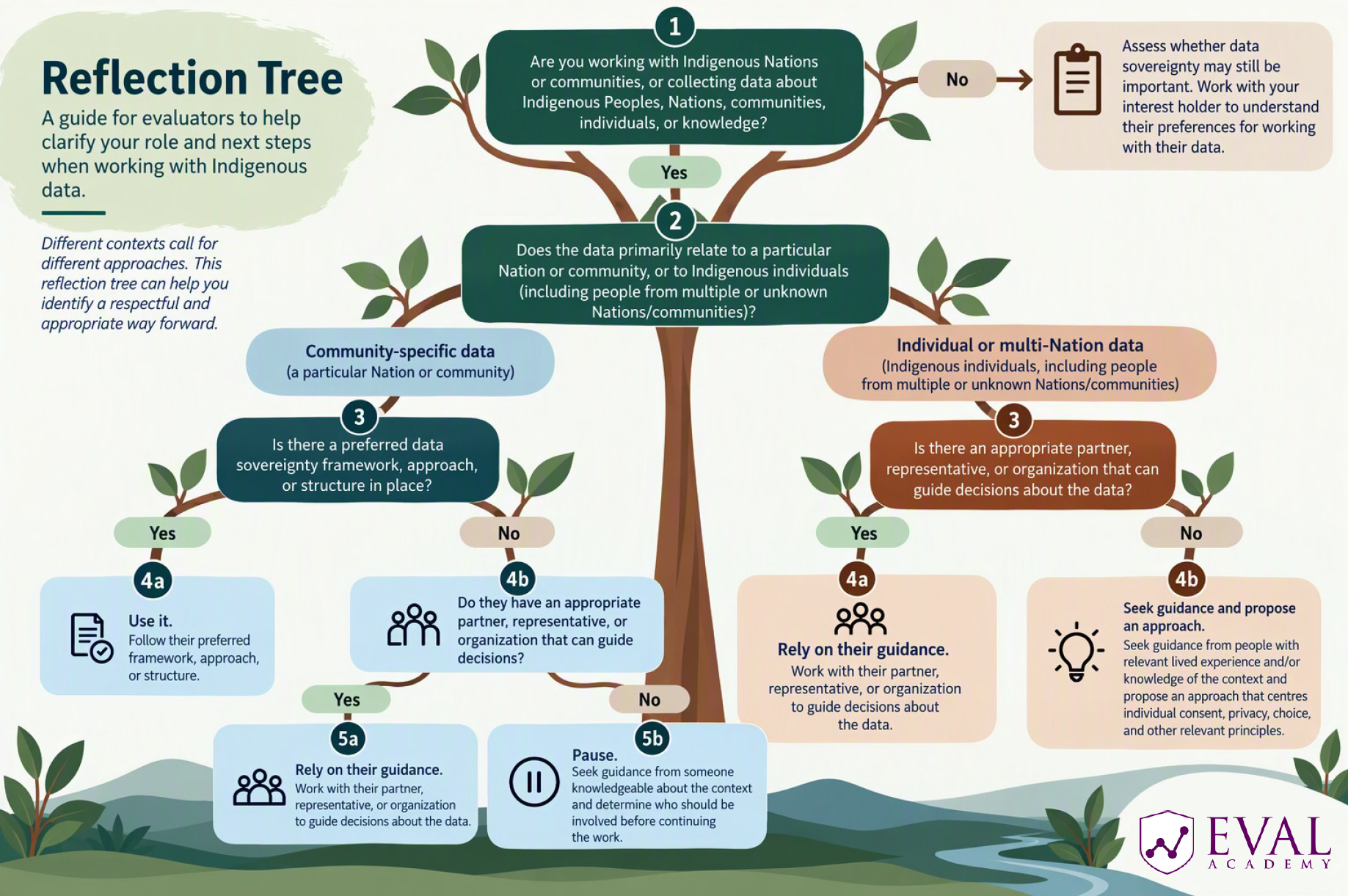
Click the image to view in a new tab and download as a PDF.