

December 2026
About the author: Bonnie Lakusta is a Project Lead at Three Hive Consulting and a Credentialed Evaluator with a doctorate in psychiatry. Bonnie’s background is grounded in research, project management, and change management within healthcare. She brings expertise in facilitation, quality improvement, and evaluation design, with a focus on creating usable data and clear, memorable key messages tailored to diverse audiences.

The first time I heard the word positivism was in the CES Essential Skills Series. The world of epistemologies was new to me. Positivism, or at least what I learned about it in a high-level overview, felt like me. It sounded so tidy: things you can measure, right answers and wrong answers. With my research background, it felt like it fit. But then, the CES Essential Skills facilitator asked the session participants which epistemology best defined us. I was the only one who raised my hand for positivism. That was a red flag.
The other end of the spectrum from positivism is epistemologies where there are multiple realities and knowledge depends on who is doing the knowing. I was confused then, and honestly, I still am. If you want a full tour of every paradigm in evaluation, I'm not your guide. I'm still learning that part.
What I can tell you is that after more than a decade of experience in evaluation, I still lean positivist, and I think it has a place, but there is so much more than that.
What is positivism?
Positivism is a philosophy about knowledge. It says that there is one objective reality, that it exists whether or not anyone is looking at it, and that we can come to know it by observing and measuring it. If we measure carefully enough, we will find it.
For an evaluator, that translates into a handful of beliefs:
There is one reality. A program either reduced wait times or it didn't.
It can be measured. If it matters, we can count it, scale it, or test it.
The evaluator stays neutral. Our values and opinions stay out of the findings.
Good methods give the same answer no matter who uses them. This is called replicability.
Cause and effect can be isolated, ideally with a comparison group.
Findings can be generalized. What works here will probably work there.
Positivism is one lens among many
It helps to see positivism next to another lens. Interpretivism is the most common counterpart to positivism. This table is a simplification, but it shows how the same evaluation can look very different depending on the lens.
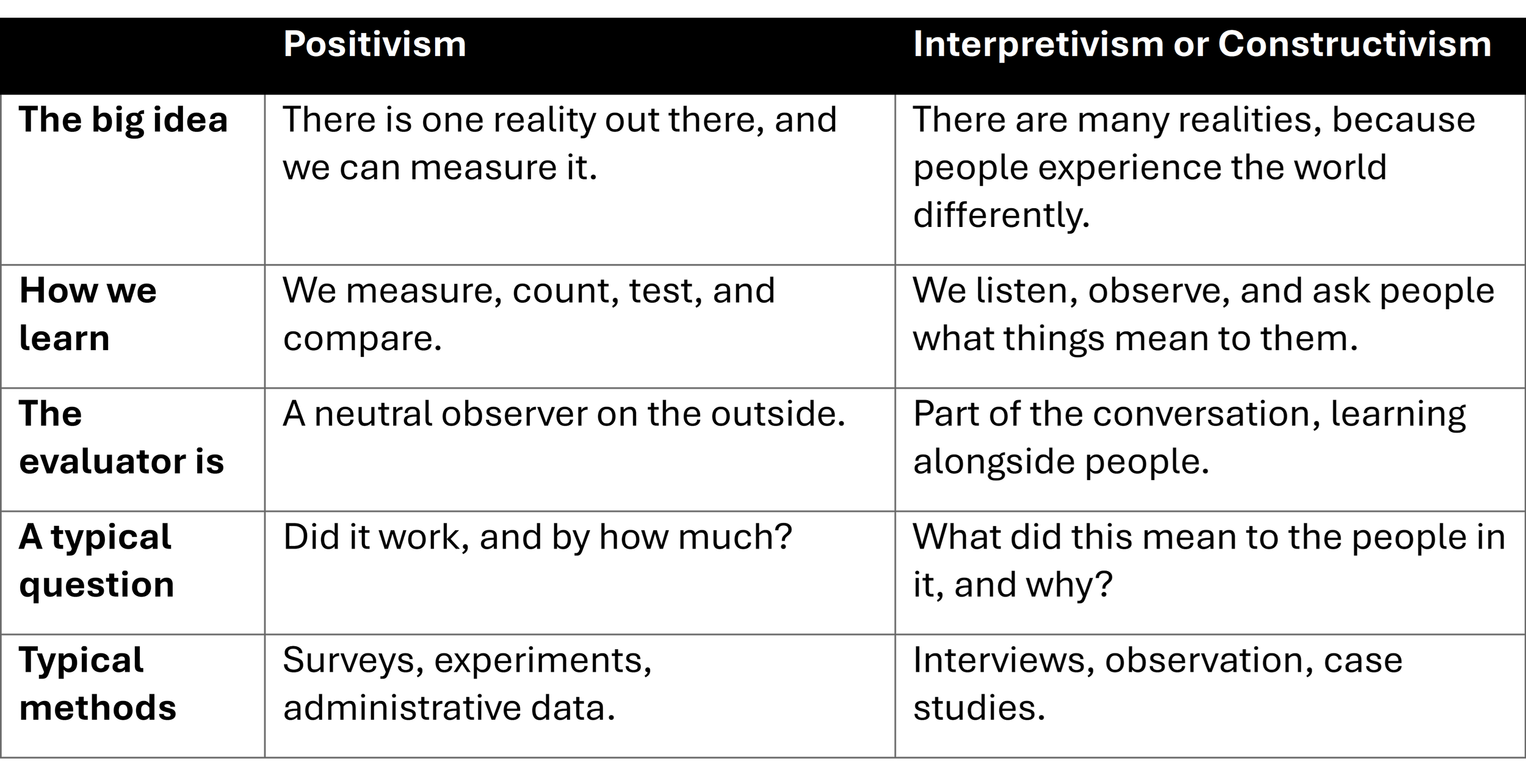
One caution: Indigenous ways of knowing and Indigenous evaluation approaches don't belong in this table. They come from their own knowledge systems, with their own ideas about relationships, responsibility, and what counts as evidence. I've left them out on purpose so I don't squeeze them into a Western framework.
Signs you might be a positivist evaluator
See how many of these sound like you.
You talk about evidence like this:
"What was the sample size?" and "Is it statistically significant?" are your first questions when someone shares a finding.
You feel uneasy when someone says "it depends."
If you can't measure it, you feel you can't say much about it.
You believe there is usually one right answer, if you have the right data.
You use words like valid, reliable, bias, and objective without thinking twice. (Fun fact, I use the words “objective” and “bias” more than any other contributor to Eval Academy)
You design evaluations like this:
Your first instinct is a comparison group, or at least a baseline and a pre/post design.
Your logic model is a straight line from inputs to activities to outputs to outcomes.
You prefer a validated scale to a survey you created yourself.
You believe a good evaluation should give the same results no matter who conducts it.
You collect data like this:
You love a survey, better yet, one using Likert scales.
Administrative data feel more trustworthy than what people tell you.
When you do code qualitative data, you want inter-rater reliability.
You count how many people said something before you decide whether it matters.
You see your role like this:
You see staying neutral as your most important job.
You worry that participatory analysis risks biasing the results.
You report like this:
You lead with tables and percentages.
Your limitations section is mostly about sample size, response rates, and missing data.
Quotes are used as illustrations, not evidence.
If you nodded at most of them, you probably lean positivist.
Where positivism earns its keep
When the question is "did it work, and by how much?" A funder who needs to know whether an intervention reduced hospital readmissions needs numbers.
When the program is clear and standardized, like a vaccination clinic or a curriculum delivered the same way at every site.
When the decision is high-stakes and the interest holders expect numbers, like scaling a program, cutting a budget, or changing a policy.
When you have a long history of robust administrative data.
When safety is involved. If a new protocol might harm people, you want to measure that carefully.
A lot of health care evaluation relies on this lens. Many health outcomes can be measured directly, like blood pressure, wait times, and readmissions, so a number is often the right answer. The people making decisions about funding, clinical guidelines, and policy usually expect that kind of evidence. And when the stakes are people's health, there's good reason to want results that don't depend on who ran the evaluation. If you evaluate in health, you'll likely be asked for indicators, targets, and comparison data. That's positivism and often it's appropriate.
Where positivism struggles
When the outcomes that matter most, like trust, belonging, and safety, don't reduce well to a score.
When power is involved. Who gets to decide what counts as success: the funder, the program, or the participants?
When the program keeps changing, or is still in development.
When the sample size is very small.
When you need to explain why.
Positivism may not be enough when what we're evaluating is complex, relational, or shaped by context (and isn’t everything shaped by context?).
That doesn't mean you throw out your objective measures. They are valuable, and they are often what funders and decision-makers need to see. Being able to say "this changed, by this much" is important, but a number rarely offers the explanation of why. “Why” is a major part of evaluation.
So, start with the measure but add the context and bring them together. When the numbers and the stories agree, you can be more confident in what you found. When they disagree, that is often the most interesting finding.
Positivism in our work
Reflecting on projects we’ve done here at Three Hive, it’s easy to see where we’ve used objective data, measures, or indicators. Almost every evaluation has something of this nature. But it’s also easy to see where we’ve layered on a constructivist view by including qualitative data, stories, and context.
1. A provincial network.
The positivist approach: We used a survey to assess how well the network was supporting partnership and collaboration. Most respondents said they better understood how to work in partnership, which looked like a clear win. But far fewer reported any change in their own organization's mandate or resources.
The additional lens: The open-text comments explained the gap. The numbers showed us what changed, and the comments told us why.
2. A financial well-being program.
The positivist approach: We used pre/post surveys and a six-month follow-up to track confidence and well-being.
The additional lens: We also used an asset-mapping exercise so participants could describe, in their own words, the personal, social, and physical resources they had. The surveys gave us a number, but the mapping gave us the detail.
3. A transitional housing program.
The positivist approach: We used administrative data, such as occupancy, length of stay, referrals, and programming hours, because it was the most reliable way to describe what the program was delivering.
The additional lens: We then added interviews with staff and partners to understand how the program was experienced. Occupancy rates told us the program was used, but the interviews told us whether people feel safe in it.
4. A program serving First Nations, Inuit, or Métis communities
The positivist approach: We used common indicators and the same start-and-finish surveys across projects, so the funder could see the big picture.
The additional lens: We used a story telling approach that allowed participants to tell us what was meaningful, and preserved their experience without aggregation. Each partner reviewed and approved how their project was represented. The common indicators gave the funder comparability. The stories preserved voices.
So where did I land?
Positivism has never been something I apply consciously. But in writing this article, I do still agree with a lot of the “signs I might be a positivist”. I most definitely bring this world view to my evaluation designs. That can be a good thing, so long as it’s not the only thing.
But over the years, working in the social sector, including alongside Indigenous partners, taught me that who is asking, who is answering, and who owns the findings all shape what we find.
Takeaways
Positivism is the belief that there is one objective reality, and that we can know it by observing and measuring it.
Evaluators who lean this way value neutrality, comparison, standardization, and numbers.
It shows up everywhere in evaluation work: how you talk about evidence, design, collect data, see your role, and report.
It works well for "did it work, and by how much?" questions. It struggles with complexity, meaning, and power.
You don't have to choose one lens. Start with the objective measure, then layer on the context and stories. The numbers show what changed, the context explains why, and together they tell you more than either one alone.
I'd love to hear where you land. Are you a fellow positivist-leaning evaluator (the sole evaluator in a room raising your hand)? And if you have a favourite explanation of epistemologies, send it my way.
If you want to keep exploring approaches in evaluation check out our new course - The Evaluation Design Toolkit!